


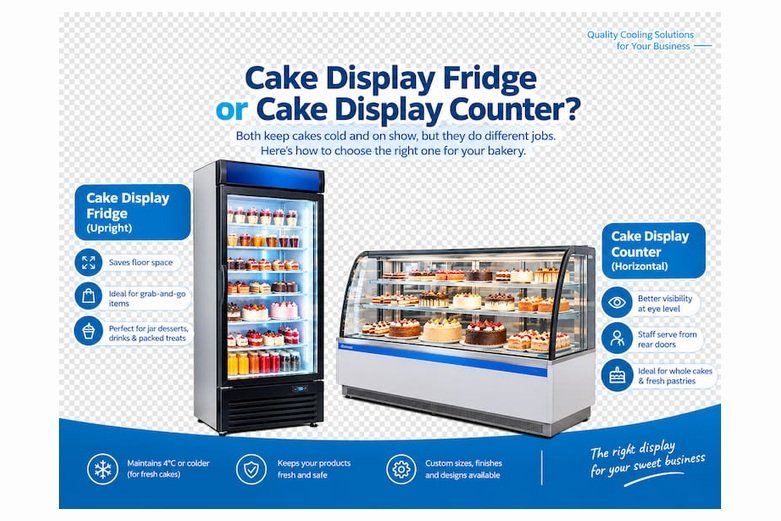
Should your bakery buy a cake display fridge or a cake display counter? Both keep cakes cold and on show, but they do different jobs. An upright cake display fridge saves floor space and suits grab-and-go items. A horizontal cake display counter suits bakeries where staff cut, box and serve to order.
This guide from Clement Refrigeration, a Bengaluru manufacturer of display cabinets and commercial refrigeration, explains how to choose.
Key takeaways
- A cake display fridge is an upright, glass-door cabinet. Choose it when floor space is tight and customers pick items themselves.
- A cake display counter is a waist-height, glass-fronted serve-over unit. Choose it when staff serve whole cakes and pastries to order.
- FSSAI’s training manual says refrigerated display units must run at 4°C or colder. Cream and fresh-fruit cakes need a unit that holds this steadily.
- Cakes dry out in strong, direct airflow. Ask how the air moves inside the unit, not only how cold it gets.
- Many busy bakeries use both: a counter for cakes and pastries, and an upright fridge for jar desserts, drinks and backup stock.
What is the difference between a cake display fridge and a cake display counter?
A cake display fridge is a tall, upright refrigerated cabinet with glass doors and several shelves, usually opened by customers. A cake display counter is a horizontal, waist-height refrigerated showcase with curved or flat front glass, opened from the back by staff. The fridge saves floor space; the counter gives a better view and controlled service.
In Indian shops, “cake showcase”, “bakery showcase”, “pastry display counter” and “cake counter” usually mean the horizontal counter. “Cake display chiller” and “upright cake fridge” usually mean the upright unit. A cold-drinks visi cooler is not a cake fridge, as we explain below.
Cake display fridge vs cake display counter: side-by-side comparison
| Factor | Cake display fridge (upright) | Cake display counter (horizontal) |
|---|---|---|
| Shape | Tall cabinet, glass door at the front | Waist-height showcase, glass front and top |
| Who opens it | Usually customers | Usually staff, from sliding or hinged rear doors |
| Floor space | Small footprint, uses wall height | Needs length along the shop front plus a staff aisle behind |
| How products are seen | Shelf by shelf, top shelves above eye level | Whole range at a glance, at eye and hand level |
| Best for | Boxed pastries, jar desserts, cheesecake slices, drinks | Whole cakes, cream pastries, made-to-order slices |
| Cold air loss | Higher when customers open the door often | Lower, because staff open rear doors briefly |
| Customisation | Limited by cabinet size | Length, glass shape, finish and branding made to fit the shop |
| Service style | Self-service, quick sale | Assisted service, upselling and custom orders |
When is a cake display fridge the better choice?
A cake display fridge is the better choice when your shop is small, your products are pre-portioned or packed, and customers serve themselves. It fits against a wall, uses height instead of floor area, and works well beside a billing counter for quick, impulse sales like jar cakes, mousse cups and packed pastries.
The trade-off is visibility. Top and bottom shelves get less attention, and every time a customer opens the door, warm shop air enters. In summer, that makes it harder to hold temperature.
When is a cake display counter the better choice?
A cake display counter is the better choice when whole cakes and fresh cream pastries are your main products and staff serve customers. It shows the full range at eye level, lets customers point and choose, and keeps the cold zone closed to the public. It is the standard unit for a full-service bakery or patisserie.
It also suits celebration cake shops, bakeries that cut slices to order, and shops that sell cakes and mithai together, where one long counter can be split into zones with different temperatures.
The trade-off is space. A counter needs room along the shop front, plus a working aisle behind it.
Planning a new bakery or a new branch? Clement Refrigeration builds cake and pastry counters to the length, glass style and finish your shop needs, and delivers across India. Call or WhatsApp +91 98860 20600 or +91 98458 08571, or visit our factory in Bommasandra, Bengaluru, to see how counters are built.
What temperature should a cake display be kept at?
FSSAI’s catering training manual states that refrigerators and refrigerated display units must be kept at 4°C or colder, and cold-holding equipment at 5°C or colder. For cream, custard and fresh-fruit cakes, choose a unit that holds 4°C or below steadily, even when the shop is hot and the doors open often.
Bakery displays are commonly sold with a 2°C to 8°C range. The warmest spot is usually just behind the front glass. For cream products, set the controller near the low end and check that spot with a probe thermometer on a hot afternoon. If it reads 4°C or below, the display is in the safe zone.
Dry cakes, cookies and rusks can sit in an ambient (non-refrigerated) zone, which saves space and power.
Does airflow matter for cakes?
Yes. A fan-assisted unit moves cold air around the cabinet, which keeps temperature even from front to back and recovers quickly after the door opens. But a strong, direct blast of air dries the surface of sponge and cream. A good cake display spreads the air gently and does not blow straight onto the products.
That is why a cold-drinks visi cooler, built to chill bottles fast with strong airflow, is a poor cake fridge. Cakes kept in one can dry out and crack at the edges.
Static (no-fan) cooling dries products less but leaves warm and cold spots in a large unit. For a full bakery counter, fan-assisted cooling with indirect air paths is the better balance. Our refrigerated counters use fan-assisted cooling, automatic defrost and digital temperature control.
Curved glass or flat glass: which suits your bakery?
Curved glass gives a wide, open view and suits premium patisserie and celebration cakes. Flat glass gives a clean, modern look, is easier to clean and is easier to replace if it breaks. Both work well. The choice depends on your shop’s design and how far customers stand from the counter.
Whichever you choose, ask for toughened glass for safety and anti-condensation glass for monsoon months and coastal cities, when humid air fogs cold glass. Choose panoramic glass if customers walk around the counter, and LED lighting, which adds little heat inside the cabinet.
How do you size a cake display for your shop?
Size your display by counting what you need to show at your busiest hour, not by picking a standard length. List your products, convert them into trays, then divide by the number of display levels. This gives the tray space you need, which a manufacturer can turn into a counter length or a cabinet size.
- List your peak-hour display: whole cakes, pastry varieties and slices on a busy Saturday evening.
- Convert to trays. A full-size Gastronorm (GN 1/1) tray is 530 mm × 325 mm. Note how many items fit on one.
- Divide by display levels. Extra shelves add trays in the same length, but tall cakes need enough deck height.
- Add room to grow for seasonal items such as Christmas plum cakes.
- Check the floor: the wall, the staff aisle and the customer space in front.
Worked example (for illustration): a bakery wants 6 whole cakes and 4 trays of pastries on show. A cake of about 20 cm diameter fits two to a GN 1/1 tray, so 6 cakes need 3 trays. That makes 7 trays in total. On a counter with two display levels, that is 4 trays per level. Placed side by side with the 325 mm edge facing the customer, 4 trays need about 1.3 metres of display length, before side panels and the cooling system are added.
What we check before building a cake counter
When we build a cake counter, we start from the shop, not from a catalogue. These are the questions our team works through with each bakery:
- Where will the counter stand? Direct sunlight, a nearby oven or an entrance door all add heat load.
- What will it hold? Cream cakes, mousse, cheesecake and dry cakes need different zones.
- Who opens it? Staff-only rear access or customer-facing doors changes the design.
- How will it look? Glass shape, finish (stainless steel, Corian, matte or custom branding panels) and lighting.
Inside, our refrigerated counters use 75 mm polyurethane foam (PUF) insulation, R290, a natural refrigerant with low global-warming potential, and food-grade stainless steel on the inside. They are designed to run steadily in rooms up to 43°C, which matters in shops where the AC is switched off after hours or struggles in summer.
You can see counters we have built that combine cakes, mithai and namkeen in one run on our sweet, cake and namkeen counter projects page.
What should you ask a manufacturer before ordering?
Before you order any cake display, ask five questions: what temperature the unit holds at the front glass in summer, how the cold air is spread, what refrigerant and insulation it uses, whether the glass is toughened and anti-condensation, and whether you will see a drawing before manufacturing starts. Clear answers to these tell you more than a brochure.
| Question | Why it matters | Good answer looks like |
|---|---|---|
| What temperature does it hold at the front glass in summer? | The front is the warmest spot | 4°C or below for cream products |
| How is cold air spread? | Strong airflow dries cakes | Fan-assisted with gentle, indirect air paths |
| What refrigerant and insulation? | Affects efficiency and heat loss | Named refrigerant (such as R290) and insulation thickness (such as 75 mm PUF) |
| What glass? | Safety and visibility | Toughened, anti-condensation |
| Will I see a drawing first? | Custom units must fit your floor | A dimensioned drawing before production |
Should a bakery have both?
Many established bakeries do. The counter at the front shows whole cakes and pastries and handles made-to-order service. An upright fridge near the billing area sells packed desserts and drinks, and a second upright unit in the back stores reserve stock so the front display can be refilled quickly during rush hours.
For a small shop, start with the unit that matches your main product: a counter for whole cakes, an upright fridge for grab-and-go desserts. Read our guide to custom vs ready-made display cabinets, or our guide on how to choose the right commercial refrigerator.
Frequently asked questions
Is a cake display fridge the same as a cake display counter?
No. A cake display fridge is an upright cabinet with glass doors, usually opened by customers. A cake display counter is a horizontal, waist-height showcase that staff open from the back. The fridge saves floor space and suits packed items; the counter shows whole cakes better and suits assisted service in a full bakery.
What temperature should a cake display fridge be?
FSSAI’s catering training manual says refrigerated display units should be kept at 4°C or colder. Cream, custard and fresh-fruit cakes need this cold zone. Dry cakes, cookies and rusks can usually sit in an ambient section. Check that the unit holds its temperature at the front of the display, not only near the cooling unit.
Can I keep cakes in a normal visi cooler?
It is not recommended for cream cakes. Visi coolers are built to chill bottles and cans fast, using strong airflow. That airflow can dry out sponge and cream over long hours. A cake display fridge or counter spreads cold air more gently and is designed to keep cakes moist and looking fresh through the day.
Which is better for cakes, curved glass or flat glass?
Both work well. Curved glass gives a wide, open view that suits premium patisserie. Flat glass looks modern, is easier to clean and costs less to replace if broken. Whichever you choose, ask for toughened glass and anti-condensation glass, especially if your shop is in a humid city or has heavy footfall.
Can a cake display counter be made to fit my shop?
Yes. A manufacturer such as Clement Refrigeration builds counters to order, so the length, glass shape, finish, lighting and branding can match your shop. A counter can also be split into chilled and ambient zones, so cakes, pastries and dry bakery items can sit in one continuous unit.
Ready to choose your cake display? Clement Refrigeration designs and manufactures cake display counters and refrigerated cabinets in Bengaluru and delivers across India. Tell us about your shop and products and we will suggest the right layout. Call or WhatsApp +91 98860 20600 or +91 98458 08571 (Monday to Saturday, 9 AM to 7 PM), request a custom quote, or see our full range of display cabinets and refrigeration.